sábado, 24 de noviembre de 2018

PUNTO DE ENCUENTRO EN LA PATAGONIA. ESTE SÁBADO EN RADIO/TV PRESIDENTE IBÁÑEZ, A PARTIR DE LAS 13.30 HORAS. INVITADOS RAMÓN DÍAZ ETEROVIC, ESCRITOR Y MARCELO AGÜERO, PRESIDENTE FUNDACIÓN OCCAP


Ramón Díaz Eterovic


Marcelo Agüero Faridoni

En la primera parte del programa, el magallánico Marcelo Agüero Faridoni nos hablará de la expedición a los canales patagónicos que se iniciará la próxima semana. Es una misión de exploración, investigación e instalación de estaciones sísmicas en los canales patagónicos y que es producto de un acuerdo entre la Fundación OCCAP y  la Washington University en St Louis (USA).


“…Esta expedición se enmarca en el Convenio de Cooperación entre la Universidad de Washington, en San Luis, junto con la Fundación OCCAP y esta expedición tiene como objetivo, que es el objetivo primario, es la instalación de ocho estaciones sismológicas, de última generación, en la cual los datos van a quedar abiertos  a la investigación chilena. Es decir, con esta información que estos equipos durante 18 meses van a estar pensando  y lanzando información hacia los satélites y almacenados en su propio sistema, en su propio disco duro va a estar disponible para diversos tipos de análisis y de estudio tanto para el Servicio Nacional de Sismología de Chile, como el Servicio de Geología . Por qué no decirlo,  en la etapa previa hubo  una cooperación también de  ENAP Magallanes, o sea, es un tema transversal para el desarrollo nacional y desarrollo regional. Hay un tema bien importante, que este sistema de medición a través de los análisis de datos va a poder también marcar algún índice con respecto a los rendimientos de los campos de hielo que eso es importante…


Ramón Díaz Eterovic


Como les conté, anteriormente, también habrá una conversación con el destacado escritor magallánico Ramón Díaz Eterovic, quien en la última Feria Internacional del Libro de Santiago, presentó un nuevo libro “La cola del diablo”, que es una nueva aventura del famoso detective Heredia y que transcurre en la ciudad de Punta Arenas.
Ramón hablará de esa novela, como también de Heredia y de los personajes que lo acompañan. Además,  nos habla de este trabajo  literario que está realizando con su hija mayor, Valentina Díaz Leyton, que es diseñadora e ilustradora de libros y del último libro que ha sido publicado, recientemente “Los tesoros del arcoíris” y que será presentado la próxima semana en Villarrica, que es donde vive su hija. Sobre el trabajo con ella nos dice que “mi hija trabaja bastante en el diseño y en algún momento ella obtuvo el patrocino del lugar donde trabaja, que es la Universidad Católica para poder desarrollar un proyecto de libros para primeros lectores y, entonces, ahí surgió la idea de compartir el trabajo y ella pone la parte gráfica y yo la historia…”


También, hace poco tiempo ha sido publicado un nuevo libro Estados Unidos. Se aprovecha para conocer, en esta conversación, la proyección que han tenido sus novelas, en diferentes partes del mundo y la próxima aparición de una novela de Heredia en el mercado de China.


También hace recuerdo de sus inicios como escritor, habla de sus proyectos para seguir escribiendo para niños y adolescentes.
Por supuesto que nos habla sobre Heredia. “…es un personaje que ya tienen 33 años en su vida. La primera novela con él como protagonista la publiqué en 1987 y se llama “la ciudad está triste”…
“… él es un detective, algo marginal, que vive en un barrio bastante popular de Santiago que es el Barrio Mapocho, el antiguo barrio de la bohemia de los escritores…”
“…él es un tipo que tiene un alto sentido, como de la ética y de la justicia; él se define como un hombre que busca verdades, que hace preguntas y yo siento y así lo han entendido personas que han estudiado las novelas, que en el desarrollo de estas historias hay una suerte de cronología de la historia política social chilena desde la época de la dictadura hasta nuestros días…”
“…en cada novela me he preocupado de abordar algún tema que tiene que ver con carencia de justicia, de desigualdad, con falta de equilibrio social en nuestro país…”
Bien si quieres conocer algo más te invito a que sintonices o veas por TV este nuevo programa de


PUNTO DE ENCUENTRO EN LA PATAGONIA

Un espacio dedicado al quehacer cultural, un encuentro con sus protagonistas, para contribuir al cambio cultural.

Creado y conducido por Roberto Bravo Vidal
El programa se trasmite por radio/TV Presidente Ibáñez de Punta Arenas todos los sábados a partir de las 13.30 horas.

Se puede escuchar y ver por internet
También se puede ver en el celular
También se verá aquí, en Facebook


Si quieres ver el programa en Facebook, puedes ingresar aquí


miércoles, 7 de noviembre de 2018

Ozone Hole Modest Despite Optimum Conditions for Ozone Depletion


Scientists from NASA and NOAA work together to track the ozone layer throughout the year and determine when the hole reaches its annual maximum extent. This year, the South Pole region of Antarctica was slightly colder than the previous few years, so the ozone hole grew larger.
Credits: NASA Goddard/ Katy Mersmann

The ozone hole that forms in the upper atmosphere over Antarctica each September was slightly above average size in 2018, NOAA and NASA scientists reported today.

Colder-than-average temperatures in the Antarctic stratosphere created ideal conditions for destroying ozone this year, but declining levels of ozone-depleting chemicals prevented the hole from as being as large as it would have been 20 years ago.
“Chlorine levels in the Antarctic stratosphere have fallen about 11 percent from the peak year in 2000,” said Paul A. Newman, chief scientist for Earth Sciences at NASA's Goddard Space Flight Center in Greenbelt, Maryland. "This year’s colder temperatures would have given us a much larger ozone hole if chlorine was still at levels we saw back in the year 2000.”
According to NASA, the annual ozone hole reached an average area coverage of 8.83 million square miles (22.9 square kilometers) in 2018, almost three times the size of the contiguous United States. It ranks 13th largest out of 40 years of NASA satellite observations. Nations of the world began phasing out the use of ozone-depleting substances in 1987 under an international treaty known as the Montreal Protocol.
The 2018 ozone hole was strongly influenced by a stable and cold Antarctic vortex — the stratospheric low pressure system that flows clockwise in the atmosphere above Antarctica. These colder conditions — among the coldest since 1979 — helped support formation of more polar stratospheric clouds, whose cloud particles activate ozone-destroying forms of chlorine and bromine compounds.
In 2016 and 2017, warmer temperatures in September limited the formation of polar stratospheric clouds and slowed the ozone hole’s growth. In 2017, the ozone hole reached a size of 7.6 million square miles (19.7 square kilometers) before starting to recover. In 2016, the hole grew to 8 million square miles (20.7 square kilometers).
However, the current ozone hole area is still large compared to the 1980s, when the depletion of the ozone layer above Antarctica was first detected. Atmospheric levels of man-made ozone-depleting substances increased up to the year 2000. Since then, they have slowly declined but remain high enough to produce significant ozone loss.

This time-lapse photo from Sept. 10, 2018, shows the flight path of an ozonesonde as it rises into the atmosphere over the South Pole from the Amundsen-Scott South Pole Station. Scientists release these balloon-borne sensors to measure the thickness of the protective ozone layer high up in the atmosphere.
Credits: Robert Schwarz/University of Minnesota

NOAA scientists said colder temperatures in 2018 allowed for near-complete elimination of ozone in a deep, 3.1-mile (5-kilometer) layer over the South Pole. This layer is where the active chemical depletion of ozone occurs on polar stratospheric clouds. The amount of ozone over the South Pole reached a minimum of 104 Dobson units on Oct. 12 — making it the 12th lowest year out of 33 years of NOAA ozonesonde measurements at the South Pole, according to NOAA scientist Bryan Johnson.
"Even with this year's optimum conditions, ozone loss was less severe in the upper altitude layers, which is what we would expect given the declining chlorine concentrations we’re seeing in the stratosphere," Johnson said.
A Dobson unit is the standard measurement for the total amount of ozone in the atmosphere above a point on Earth's surface, and it represents the number of ozone molecules required to create a layer of pure ozone 0.01 millimeters thick at a temperature of 32 degrees Fahrenheit (0 degrees Celsius) at an atmospheric pressure equivalent to Earth’s surface. A value of 104 Dobson units would be a layer that is 1.04 millimeters thick at the surface, less than the thickness of a dime.
Prior to the emergence of the Antarctic ozone hole in the 1970s, the average amount of ozone above the South Pole in September and October ranged from 250 to 350 Dobson units.
What is ozone and why does it matter?
Ozone comprises three oxygen atoms and is highly reactive with other chemicals. In the stratosphere, roughly 7 to 25 miles (about 11 to 40 kilometers) above Earth’s surface, a layer of ozone acts like sunscreen, shielding the planet from ultraviolet radiation that can cause skin cancer and cataracts, suppress immune systems and damage plants. Ozone can also be created by photochemical reactions between the Sun and pollution from vehicle emissions and other sources, forming harmful smog in the lower atmosphere.
NASA and NOAA use three complementary instrumental methods to monitor the growth and breakup of the ozone hole each year. Satellite instruments like the Ozone Monitoring Instrument on NASA’s Aura satellite and the Ozone Mapping Profiler Suite on the NASA-NOAA Suomi National Polar-orbiting Partnership satellite measure ozone across large areas from space. The Aura satellite’s Microwave Limb Sounder also measures certain chlorine-containing gases, providing estimates of total chlorine levels.
The total amount of ozone in the atmosphere is exceedingly small. All of the ozone in a column of the atmosphere extending from the ground to space would be 300 Dobson units, approximately the thickness of two pennies stacked one on top of the other.
NOAA scientists monitor the thickness of the ozone layer and its vertical distribution above the South Pole by regularly releasing weather balloons carrying ozone-measuring “sondes” up to 21 miles (~34 kilometers) in altitude, and with a ground-based instrument called a Dobson spectrophotometer.
To learn more about NOAA and NASA efforts to monitor ozone and ozone-depleting gases, visit:
Last Updated: Nov. 2, 2018
Editor: Sara Blumberg

NASA

sábado, 3 de noviembre de 2018

HOY EN PUNTO DE ENCUENTRO EN LA PATAGONIA ESTARÁ EL CANTAUTOR Eduardo Yáñez Betancourt. A PARTIR DE LAS 13.30 HORAS EN RADIO/TV PRESIDENTE IBÁÑEZ.

La imagen puede contener: Eduardo Yáñez Betancourt y Roberto Bravo Vidal, personas sentadas e interior

El destacado cantautor Eduado Yañez Bettancourt es el invitado del programa Punto del Encuentro en la Patagonia que se trasmite en radio/TV Presidente Ibáñez este sábado a partir de las 13.30 horas.
En él junto con escuchar algunos de sus temas, Eduardo habla y recuerda sus inicios en la música durante su adolescencia, como aquella de la “nueva ola” y artistas de esa época. También recuerda sus primeras composiciones en la adolescencia, como su ingreso a la universidad en el año 70. Nos cuenta de uno de sus temas más conocido “Nuestro cobre”, ganador del Festival del Cantar Universitario del año 1971, que el conjunto Quilapayún grabó en 1972 y que él recién la grabó en el año 2003.

La imagen puede contener: Eduardo Yáñez Betancourt, sentado, guitarra e interior

Sobre la temática de sus composiciones Eduardo dice en parte “…eso que te conmueve, esa cosa humana; hay frases, que siendo “cliché” también son verdaderas, nada de lo humano me es ajeno. Claro, eso que, tú tienes el conjunto de la humanidad, las guerras, las injusticias, pero también tienes a ese caballero de la plaza que se sienta en la plaza y da de comer a las palomas. Y ese niño que está aprendiendo a caminar y esa persona que hoy día se puso triste, que tú no la conoces, te sientas al lado y conversas con él y qué le pasa…"


La imagen puede contener: una o varias personas, personas tocando instrumentos musicales y guitarra

Nos habla del Victor Jara a quien conoció y cuenta que estuvieron juntos en el estadio Chile. Nos cuenta y canta, además, un tema que le escribió y que está en el CD “Eduardo Yañez, Para llegar al amor”
La política también estuvo presente en esta conversación como su visión del momento cultural.
La entrevista fue realizada el 10 de enero de este año.

PUNTO DE ENCUENTRO EN LA PATAGONIA
Un espacio dedicado al quehacer cultural, un encuentro con sus protagonistas, para contribuir al cambio cultural.
Creado y conducido por Roberto Bravo Vidal
El programa se trasmite por radio/TV Presidente Ibañez de Punta Arenas todos los sábados a partir de las 13.30 horas.
Se puede escuchar y ver por internet
http://www.radiopresidenteibanez.cl
También se puede ver en el celular
http://ibanez.servercl.com/live/live/index.m3u8
También se verá aquí, en Facebook

martes, 23 de octubre de 2018

ANTÁRTICA: Antarctic ice mission seeks mystery molecules that scrub sky/La misión de hielo en la Antártida busca moléculas misteriosas que frotan el cielo.

Air bubbles in a thin section of an ice core (Photo: Mana Inoue)

This summer a world-first international mission will build a temporary lab on the Antarctic ice sheet to reveal how much a natural ‘atmospheric detergent’ cleans the air of harmful trace gases.

Although the majority of greenhouse gas emissions is carbon dioxide, there are more than 40 other gases that contribute to climate change and depletion of the ozone layer.

The Law Dome Hydroxyl project, led by CSIRO atmospheric scientist Dr David Etheridge and Dr Vas Petrenko from the University of Rochester in the USA, seeks to understand the natural processes that remove these ‘other’ climate change gases from the atmosphere.

“Hydroxyl (OH) is a naturally occurring, highly reactive molecule that plays an important role in the atmosphere as a ‘natural air purifier’, by destroying greenhouse gases like methane and industrial chemicals that deplete ozone,” said Dr Etheridge.

“But we don't understand how much has been removed by hydroxyl, which is fundamental to be able to predict the levels of gases that affect climate and the ozone layer into the future.”

“Knowing how hydroxyl varies in the atmosphere, and the role it plays, is the key to solving those mysteries.”

Researchers will drill ice cores to depths of 250 metres to measure pre-industrial atmospheric levels of hydroxyl, which has never been done before.

To do this, the team will traverse more than a hundred kilometres from Australia’s Casey research station to Law Dome and set up a laboratory on the ice sheet for three months.

“Law Dome is the best place on the planet to get old air for this project, because its enormous rate of snowfall traps air quickly and preserves it at depth for centuries,” said Dr Etheridge.

However, the project is a massive challenge because of the tiny amounts of material that the researchers need to sample and analyse.

“Melting hundreds of kilograms of ice will yield about 30 litres of air, but each air sample will yield just a handful of the molecules we want to detect and measure.”

“The concentrations we’re looking for are so miniscule it’s like trying to find a few particular grains of sand amongst the trillions on a beach,” Dr Etheridge said.

This season more than 500 expeditioners will travel south with the Australian Antarctic Program to Casey, Davis and Mawson stations and sub-Antarctic Macquarie Island.

Australia’s Wilkins Aerodrome will be closed for three months to undertake engineering works on the 3.5 kilometre blue ice runway near Casey.

Across at Davis research station, a team will undertake some further environmental investigations of the proposed paved runway.

The Law Dome expedition is a US-Australian collaborative project involving glaciologists and atmospheric scientists from CSIRO, the Australian Nuclear Science Technology Organisation (ANSTO), the University of Rochester, Scripps Institution of Oceanography, the US National Science Foundation, and AAD.


Australian Antartic Division

Este verano, una primera misión internacional del mundo construirá un laboratorio temporal en la capa de hielo de la Antártida para revelar cuánto un "detergente atmosférico" natural limpia el aire de gases traza dañinos.

Aunque la mayoría de las emisiones de gases de efecto invernadero son dióxido de carbono, hay más de 40 gases que contribuyen al cambio climático y al agotamiento de la capa de ozono.

El proyecto Law Dome Hydroxyl, dirigido por el científico atmosférico CSIRO, el Dr. David Etheridge y el Dr. Vas Petrenko de la Universidad de Rochester en los Estados Unidos, busca comprender los procesos naturales que eliminan estos “otros” gases del cambio climático de la atmósfera.

"El hidroxilo (OH) es una molécula altamente reactiva de origen natural que desempeña un papel importante en la atmósfera como un" purificador de aire natural ", al destruir gases de efecto invernadero como el metano y los productos químicos industriales que agotan el ozono", dijo el Dr. Etheridge.

"Pero no entendemos cuánto ha eliminado el hidroxilo, que es fundamental para poder predecir los niveles de gases que afectan el clima y la capa de ozono en el futuro".

"Saber cómo varía el hidroxilo en la atmósfera, y el papel que desempeña, es la clave para resolver esos misterios".

Los investigadores perforarán núcleos de hielo a profundidades de 250 metros para medir los niveles atmosféricos preindustriales de hidroxilo, algo que nunca antes se había hecho.

Para hacer esto, el equipo recorrerá más de cien kilómetros desde la estación de investigación de Casey en Australia hasta Law Dome y establecerá un laboratorio en la capa de hielo durante tres meses.

"Law Dome es el mejor lugar del planeta para obtener aire viejo para este proyecto, ya que su enorme cantidad de nevadas atrapa el aire rápidamente y lo preserva en profundidad durante siglos", dijo el Dr. Etheridge.

Sin embargo, el proyecto es un desafío enorme debido a las pequeñas cantidades de material que los investigadores necesitan muestrear y analizar.

"La fusión de cientos de kilogramos de hielo producirá aproximadamente 30 litros de aire, pero cada muestra de aire producirá solo un puñado de las moléculas que queremos detectar y medir".

"Las concentraciones que buscamos son tan minúsculas que es como tratar de encontrar algunos granos particulares de arena entre los trillones en una playa", dijo el Dr. Etheridge.

Esta temporada, más de 500 expedicionarios viajarán al sur con el Programa Antártico Australiano a las estaciones Casey, Davis y Mawson y a la isla subantártica Macquarie.

El aeródromo Wilkins de Australia permanecerá cerrado durante tres meses para realizar trabajos de ingeniería en la pista de hielo azul de 3,5 kilómetros cerca de Casey.

Al otro lado de la estación de investigación Davis, un equipo emprenderá algunas investigaciones ambientales adicionales de la pista pavimentada propuesta.

La expedición Law Dome es un proyecto colaborativo entre Estados Unidos y Australia que involucra a glaciólogos y científicos atmosféricos de CSIRO, la Organización Australiana de Tecnología de Ciencia Nuclear (ANSTO), la Universidad de Rochester, el Instituto Scripps de Oceanografía, la Fundación Nacional de Ciencia de los Estados Unidos y AAD.

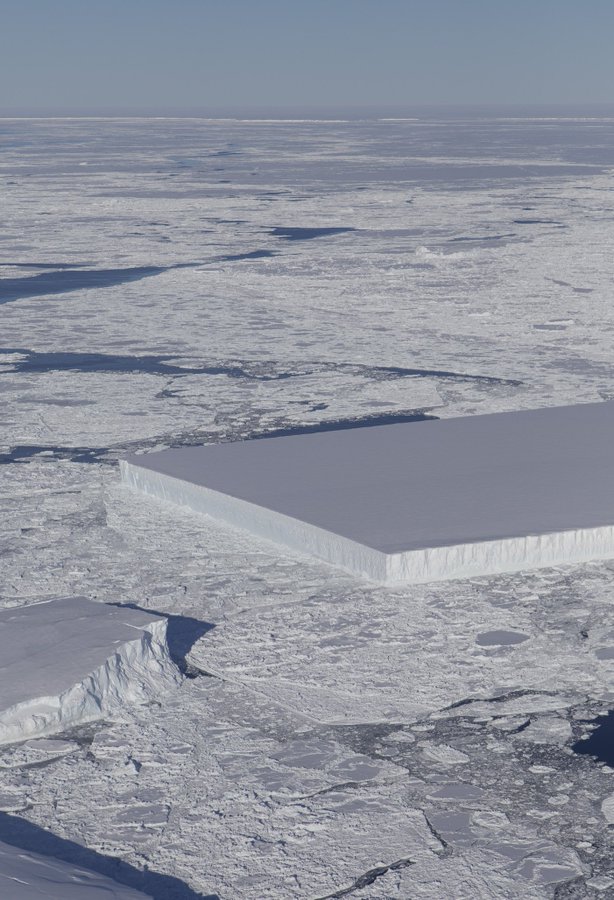
NASA descubre un misterioso bloque de hielo en Antártica

NASA descubre un misterioso bloque de hielo en Antártica

La NASA compartió imágenes de un bloque de hielo que sorprende al mundo

La imagen revela un bloque con la forma de rectángulo perfecto. Fue tomada por Operation IceBridge, una misión de la NASA en los polos del planeta. 
La explicación al fenómeno que parece una construcción artificial es que se trata de un iceberg tabular. Estos se distinguen por tener lados escarpados, casi verticales y una parte superior plana que luce como una meseta. Los icebergs tabulares  se desprenden de plataformas de hielo, que son cuerpos tabulares de hielo grueso. Se cree que el de la imagen es un iceberg reciente ya que el viento o el mar no han cambiado su forma.
Ver imagen en Twitter
From yesterday's flight: A tabular iceberg can be seen on the right, floating among sea ice just off of the Larsen C ice shelf. The iceberg's sharp angles and flat surface indicate that it probably recently calved from the ice shelf.

Los exploradores todavía no han medido el iceberg en cuestión. En 2000, el Iceberg B-15 medía 183 millas de largo por 23 millas de ancho, mayor a la extensión de la isla de Jamaica. 

Ver imagen en Twitter
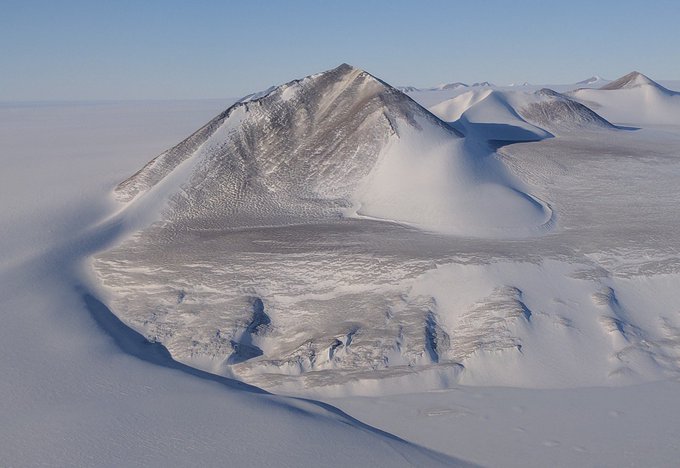
From yesterday's flight: Mountains in the Shackleton Range, bordering Recovery Glacier, East Antarctica.


EL DIARIO